

BMVC 2026
Re-calibrated Contrastive Loss for Transformation-Aware Prompt Conditioning in Vision-Language Models
Describe each image’s transformation in its text prompt, and re-calibrate the contrastive loss against positive-gradient dilution.
- 1Department of Artificial Intelligence, Ajou University
- 2Department of Computer Engineering, Ajou University
- †Corresponding author
- Paper Soon
- arXiv
- Code
- Checkpoints
Top ID accuracy, best OOD mean
- OOD mean and H.M. on ImageNet distribution shift, tied best ID (ViT-B/16)
- SOTA
- points of ImageNet OOD mean over the best prior method (ViT-B/16)
- +0.9
- points of iWildCam H.M. (macro F1) over the best prior method (ViT-B/16)
- +1.4
Try it: describe the augmentation
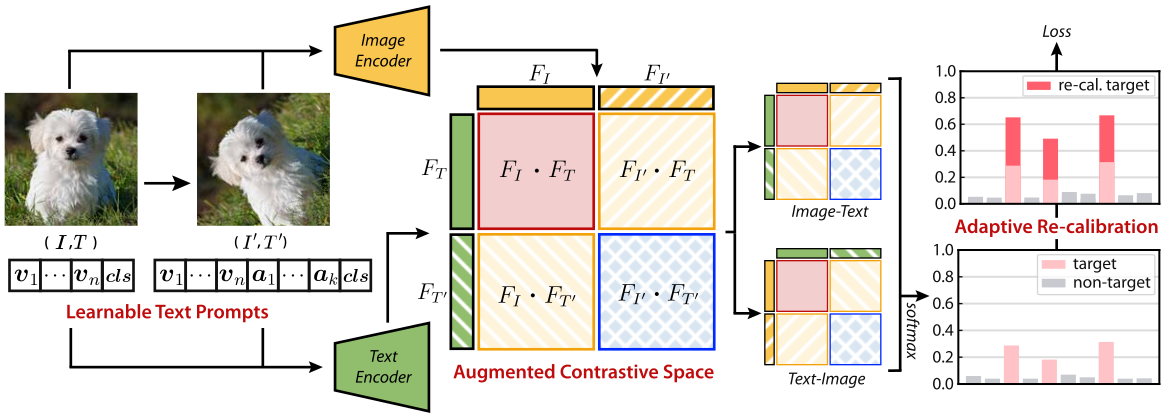
Step 1 of 5 · PairA clean image I and its prompt T: four learnable context tokens and the class name. In a labeled batch of two dogs and a cat, the other dog's prompt is a positive too, so soft-target cross-entropy splits the target in half.
Drag across the progress bar, tap a step or press Play, and pick any two RandAugment operations (the paper uses k = 2). The photo is the one in the paper's Figure 2; image operations are browser approximations and the descriptor words are illustrative.
Describe the augmentation, then re-calibrate
Transformation-aware prompt conditioning
The text prompt is M = [V, A, CLS]: learnable context V, a fixed transformation descriptor A that describes the RandAugment operations applied to the paired image, and the class token. A comes from the RandAugment dictionary and is never updated; within the prompt only V is learned. The descriptor gives the text transformation-level consistency without altering class semantics.
Augmented contrastive space
Each clean image and prompt also produces a transformed image and a transformation-conditioned prompt. The loss uses all four matches, [I I′] ↔ [T T′], and treats same-class samples as positives rather than as distinct instances.
Re-calibrated contrastive loss
With many positives per anchor, soft-target cross-entropy gives each one a target weight of 1/|P(i)|, so its gradient shrinks as positives are added: positive-gradient dilution. The re-calibrated loss adds one adaptive margin, −log ψ(i), where the re-calibration factor ψ(i) is the ratio of positive to negative evidence for that anchor. The margin is not divided by |P(i)|, so it keeps full strength as positives grow.
Better OOD transfer
ReCalCon ties the best ID accuracy with ViT-B/16 and leads it with ViT-B/32, gives the best OOD mean, harmonic mean and iWildCam score with both backbones, and the best transfer mean with ViT-B/16.
- LP-FTICLR’22
- WiseFTCVPR’22
- FLYPCVPR’23
- ARFCVPR’24
- Lipsum-FTICLR’24
- RAda-FTICCV’25
- Ours
| ImageNet | iWildCam | ||||||||||
|---|---|---|---|---|---|---|---|---|---|---|---|
| ID | -R | -A | -V2 | -Sketch | ObjectNet | OOD mean | H.M. | ID | OOD | H.M. | |
| ViT-B/16, FFT | ±0.0 | −4.3 | +3.2 | +0.5 | ±0.0 | +1.6 | +0.9 | +0.7 | +1.0 | +0.6 | +1.4 |
| ViT-B/32, FFT | +1.8 | −4.0 | +4.4 | +1.3 | −0.9 | +4.0 | +1.0 | +1.3 | +1.3 | +2.3 | +2.0 |
Keeps improving with longer training
From 10 to 25 epochs, FFT, WiseFT and FLYP lose ID accuracy and harmonic mean. ReCalCon gains on both.
ID accuracy (%)
- FFT
- WiseFT
- FLYP
- Ours
H.M. of ID and OOD (%)
- FFT
- WiseFT
- FLYP
- Ours
The descriptor has to match
Describing the wrong transformation is worse than no descriptor at all; only the matching descriptor beats having none.
- No descriptor
- Mismatched descriptor
- Matched descriptor (ours)
Citation
@inproceedings{oh2026recalibrated,
  title     = {Re-calibrated Contrastive Loss for Transformation-Aware Prompt Conditioning in Vision-Language Models},
  author    = {Oh, Seungmin and Kang, Seunghun and Ryu, Jongbin},
  booktitle = {Proceedings of the British Machine Vision Conference},
  year      = {2026},
  publisher = {BMVA},
  url       = {https://arxiv.org/abs/2609.06967}
}