Seungmin Oh

Seungmin Oh 오승민

Ph.D. Candidate, Computational Intelligence Lab, Ajou UniversityAdvised by Prof. Jongbin Ryu

I make large neural networks efficient enough to run under tight compute limits, on edge devices and inside robot control loops.

News

  • Aug 2026

    Two papers accepted to EMNLP 2026: Train Overcomplete, Deploy Compact, and Layer-wise Curriculum Learning.

  • Aug 2026

    Paper accepted to BMVC 2026: Re-calibrated Contrastive Loss for Transformation-Aware Prompt Conditioning.

  • Sep 2025

    Selected for the Doctoral Research Grant, a two-year award from NRF Korea.

  • Apr 2025

    First place, IEEE Low-Power Computer Vision Challenge Track 1 at the CVPR 2025 workshop, deployed on Snapdragon via Qualcomm AI Hub.

  • Sep 2024

    Paper accepted to ACCV 2024: Neural Substitution for Branch-Level Re-parameterization.

  • Sep 2024

    Filed a PCT patent on a neural-network CT triage classifier.

  • Apr 2024

    Paper on the origins of CNN and ViT architectures published in Scientific Reports.

  • Dec 2023

    Paper on CT-based small bowel obstruction triage published in the International Journal of Surgery.

Research

Vision-language-action models for robotic manipulation

I want VLA policies to hold up inside real robot control loops, which means three things at once: training that transfers across embodiments, inference cheap enough to run every control step, and failures caught early enough for the policy to recover.

Efficient LLM compression

Structured pruning leaves a model that has to relearn what was removed. I work on giving that recovery enough capacity, and on scheduling compression so the error that accumulates in deeper layers is paid down first (EMNLP 2026).

Efficient vision and test-time adaptation

Making vision models cheap without giving up accuracy: re-parameterization at branch level (ACCV 2024), transfer that keeps a vision-language model general (BMVC 2026), and adaptation at test time under distribution shift. The same drive won Track 1 of the 2025 IEEE Low-Power Computer Vision Challenge.

Publications and patents

2026
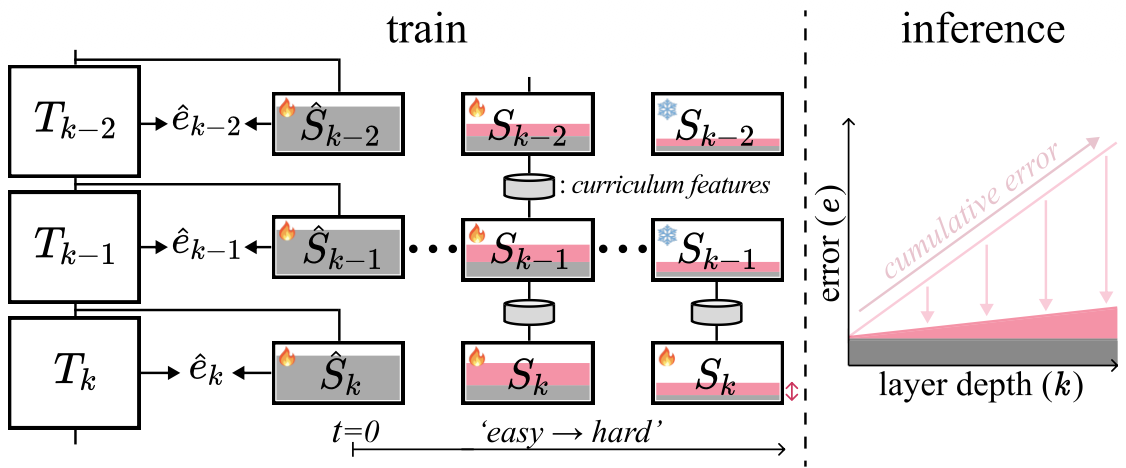
  1. Layer-wise curriculum with cumulative error over depth

    Layer-wise Curriculum Learning for Efficient LLM Compression

    Compression error accumulates in deeper layers. Shifting the optimization budget toward them as training proceeds converges 1.7× faster while halving GPU memory and hours.

    Empirical Methods in Natural Language Processing, 2026papercode

    • LLM
    • EfficientAI
    • Curriculum Learning
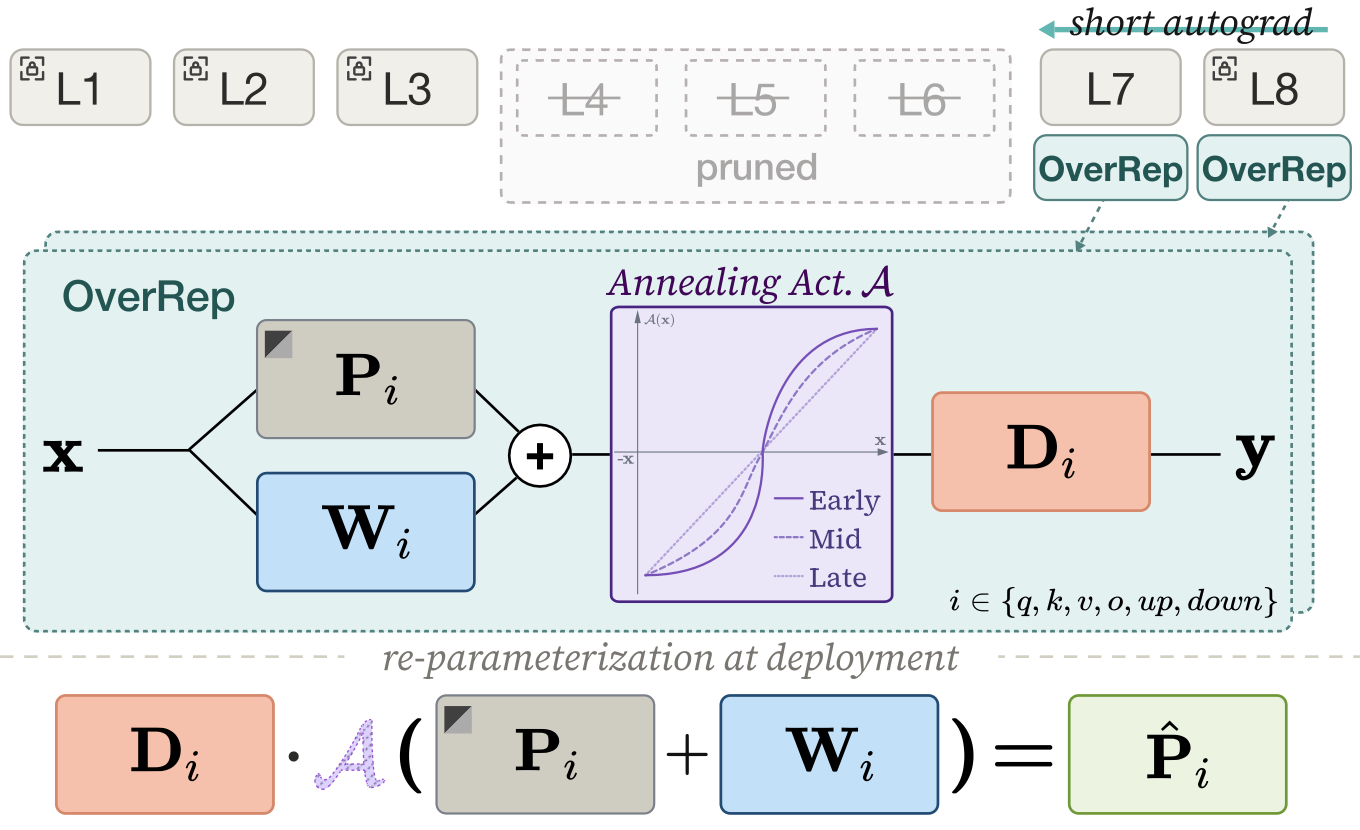
  2. Overcomplete recovery module merged at deployment

    Train Overcomplete, Deploy Compact: Scaling Recovery Capacity for Structured LLM Pruning

    After pruning, the recovery module is too small to relearn what was removed. Training it overcomplete, then merging it back, gains up to 8.4 points at no deployment cost.

    Empirical Methods in Natural Language Processing, 2026papercode

    • LLM
    • EfficientAI
    • Re-parameterization
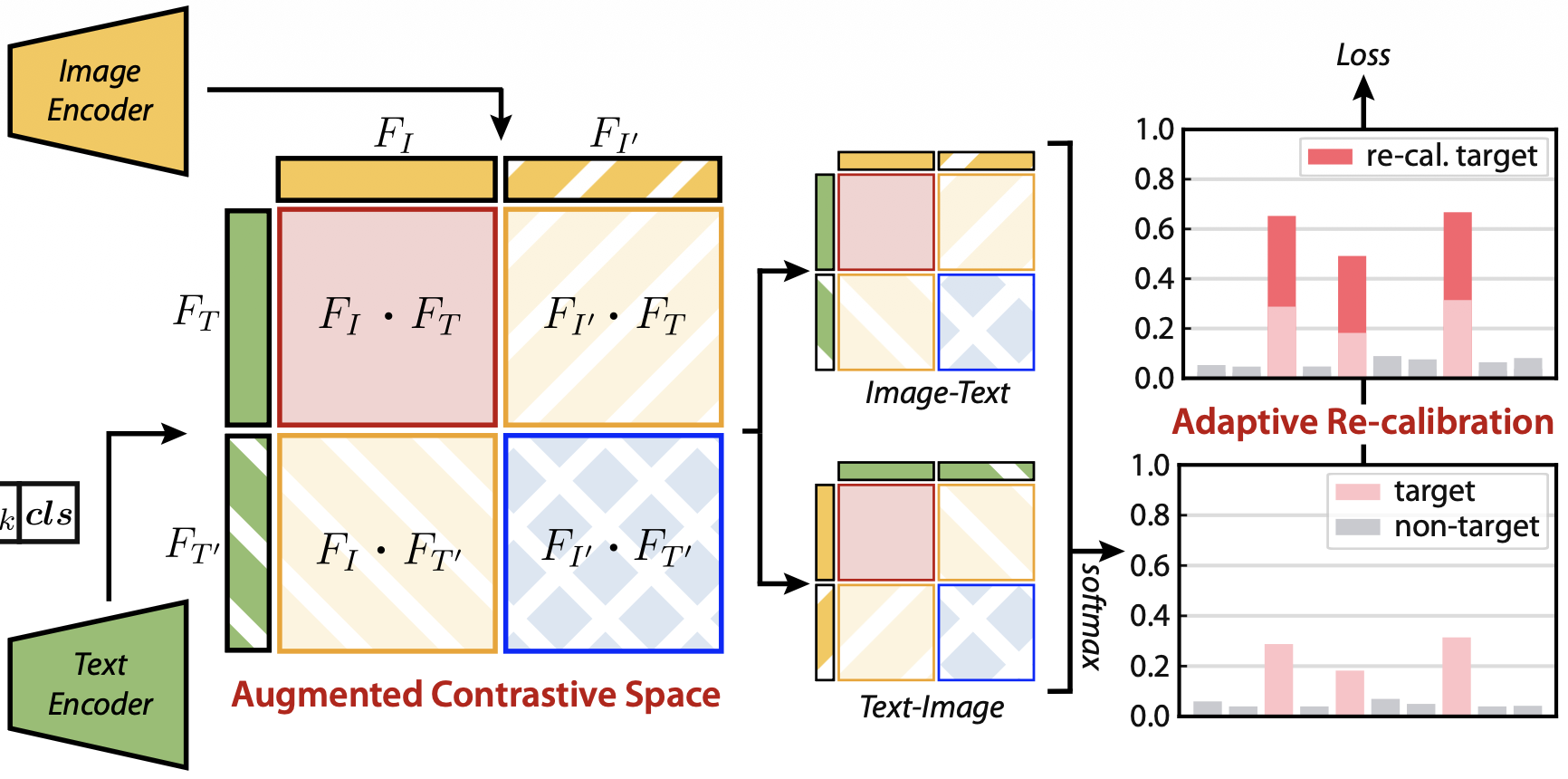
  3. Augmented contrastive space with adaptive re-calibration

    Re-calibrated Contrastive Loss for Transformation-Aware Prompt Conditioning in Vision-Language Models

    Fine-tuning a vision-language model compromises its generalization. Transformation-aware prompt conditioning, under a loss re-calibrated for multiple positives, retains both.

    British Machine Vision Conference, 2026papercode

    • VLM
    • Learning Methodology
2025
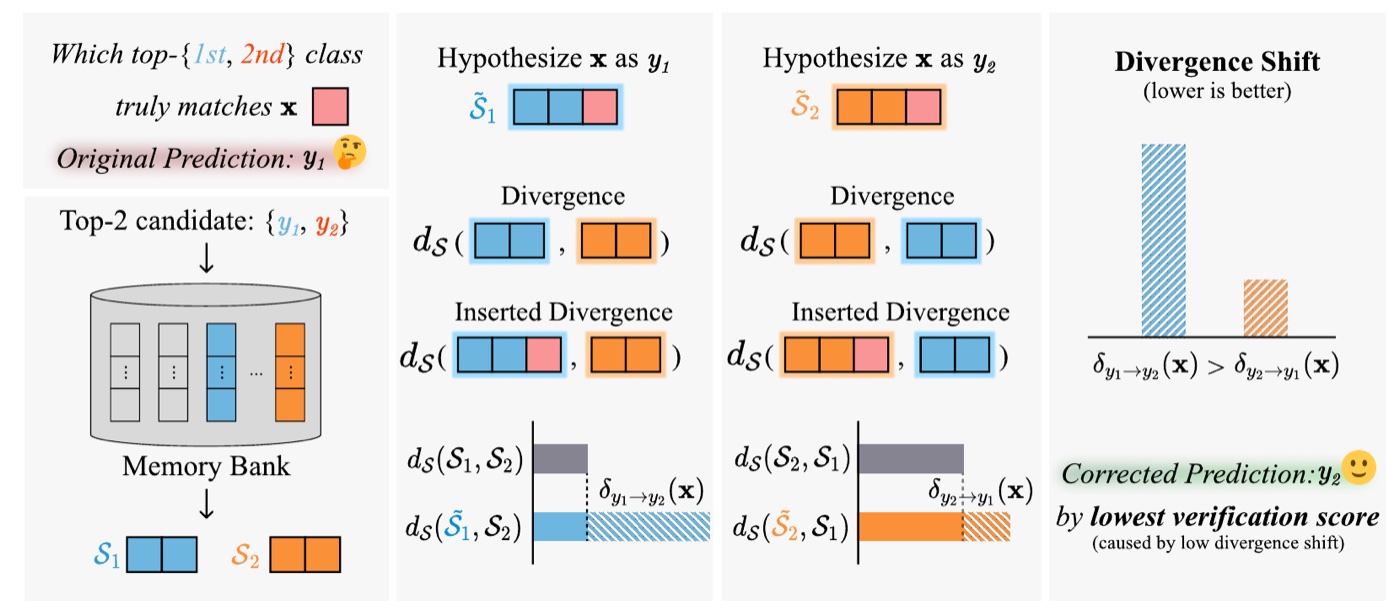
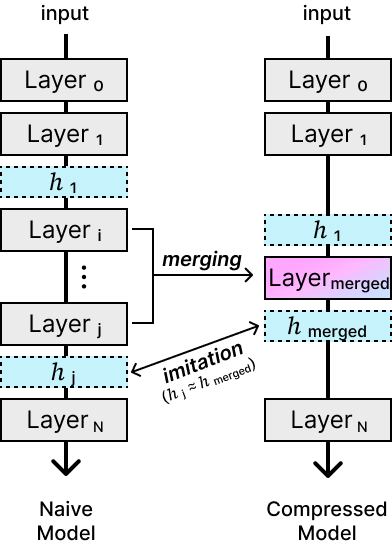
  1. Layer merging with hidden-state imitation

    Evaluation of Winning Solutions of 2025 Low Power Computer Vision Challenge

    The 2025 challenge benchmarked efficient vision models on real edge hardware. This report covers the competition design and the winning entries, including our Track 1 solution.

    arXiv preprint, 2026papercode

    • VLM
    • EfficientAI
    • Edge Deployment
2024
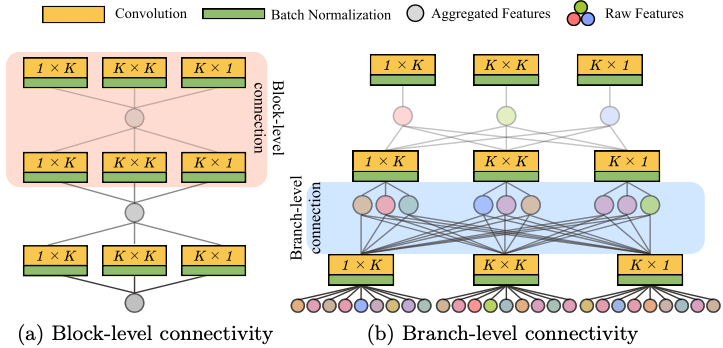
  1. Block-level versus branch-level connectivity

    Neural Substitution for Branch-Level Network Re-parameterization

    Re-parameterization usually works only within a block. Substituting local paths in training keeps branch-level connectivity and folds activations into the linear form.

    Asian Conference on Computer Vision, 2024papercode

    • Vision
    • Re-parameterization
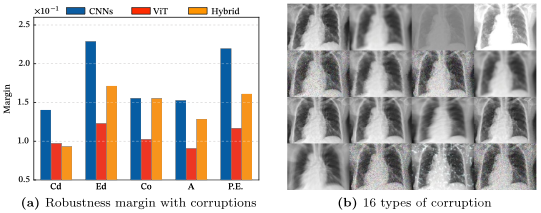
  2. CNN and ViT robustness comparison

    Analyzing to Discover Origins of CNNs and ViT Architectures in Medical Images

    Why do CNNs and ViTs behave differently on medical scans? We redo robustness, invariance, and shape-texture analyses to trace where each architecture's behavior originates.

    Scientific Reports, 2024papercode

    • Vision
    • Architecture
    • Analysis
  3. Patient cohort selection flow

    Neural Network Classifier for Predicting High-Risk Small Bowel Obstruction Using Abdominal CT Images

    A neural-network classifier that reads abdominal CT to predict high-risk small bowel obstruction, filed as a PCT patent from the clinical study below.

    PCT Patent Applicationfiled 2024

    • Vision
    • Medical
    • Patent
2023
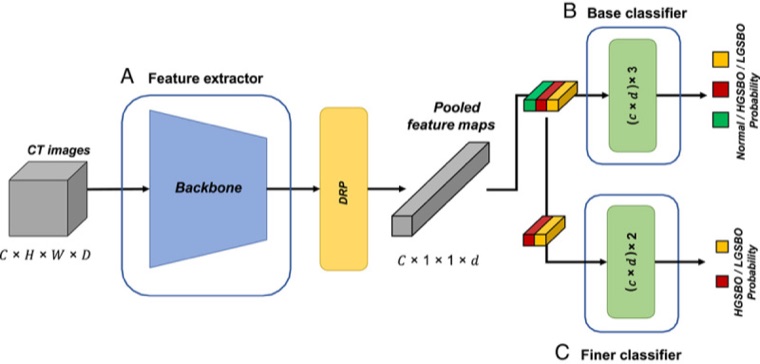
  1. Dual-branch CT classifier architecture

    Deep Learning Using Computed Tomography to Identify High-Risk Patients for Acute Small Bowel Obstruction

    Judging who needs surgery for small bowel obstruction is hard from CT alone. A dual-branch 3D CNN flags high-risk patients at 0.90 AUROC on a multi-center cohort.

    International Journal of Surgery, 2023papercode

    • Vision
    • 3D CNN
    • Clinical Prediction

Projects

  • Real-time detection transformer for autonomous driving

  • Source-free domain adaptation for on-device face recognition

  • Masked-face recognition with domain adaptation

  • Lymphoma recognition and survival analysis from 3D CT

Research funding

  • $36K

    Doctoral Research Grant

    NRF KoreaSep 2025 - Aug 2027

    Progressive Linear Activation for Depth-wise Reparameterization of Large-scale Models

  • $20K

    Lesion-Class Re-labeling in Medical Image Training Data

    NIA KoreaOct 2022 - Dec 2023

Honors and awards

  • First place

    IEEE Low-Power Computer Vision Challenge

    Track 1 of 45 teams, at the CVPR workshop2025

    Layer Imitation: Efficient Vision-Language Model on the Mobile NPU

  • Global Top 100

    Google Solution Challenge

    Google2023

    Smiler: An Expression-Training App for Children with ASD

  • Excellence Award

    ICT Mentoring Conference

    ACK, KOSIA2021

    Recommender System for Web Search Based on NLP to Improve User Search Environment

  • First Prize

    Student Paper Competition

    Korea Digital Contents Society2021

    Lightweight Video Search Using Video-to-Text Generation and Retrieval

In progress

  • New VLA training mechanism

    Changing what the policy is trained to predict, so skills carry across robots instead of binding to one.

  • Efficient VLA inference

    Cutting the compute spent on every control step while keeping task success.

  • Closed-loop failure detection

    Noticing that an action is going wrong early enough for the policy to recover.

  • Efficient test-time adaptation

    Adapting under distribution shift at inference time, cheaply and without collapse.

  • Adaptive regularization

    Letting regularization respond to the data instead of applying one fixed strength.

Beyond papers

I built and operated our lab's GPU cluster, which consists of about 20 nodes with eight RTX 3090s each. This work included containerized provisioning, per-node CUDA isolation, and training jobs that ran unattended for days. Outside of research, I taught AI tutorials for undergraduate research assistants and helped launch the Google Developer Student Club chapter at Ajou University.